In B2B textiles, you’re not just selling fabric you’re selling confidence. Buyers don’t hesitate because they dislike your fabric. They hesitate because they can’t clearly visualize what it becomes: how it looks as a garment, how the motif scales across a body, how the texture reads in real lighting, and whether the final product will match their market.
That’s why AI fabric presentation is quickly becoming a competitive advantage for mills, exporters, manufacturers, wholesalers, and agents. It upgrades how you show fabric to buyers turning a simple swatch photo into a complete product story: garment previews, digital catalogs, faster approvals, and fewer back-and-forth cycles.
This blog explains how AI fabric presentation improves B2B textile sales, how it supports textile product visualization, how to build a digital textile catalog, and how workflows like fabric to garment design and AI garment visualization can speed textile buyer approvals while helping teams reduce textile sampling.
Why fabric presentation is the real “sales funnel” in B2B textiles
B2B selling often looks logical price, MOQ, lead time, testing standards. But in practice, the first gate is still visual.
When a buyer sees only raw fabric photos, common questions follow:
-
“How will it look stitched?”
-
“Is the print too large on a full kurti/shirt/dress?”
-
“Can you show it on a model?”
-
“Do you have sample garments?”
-
“Send more angles / better lighting / a video.”
Each question adds time. Time kills deals especially when buyers are comparing 5 suppliers at once.
So the goal isn’t “more photos.” The goal is better presentation:
-
clearer visual proof
-
consistent catalogs
-
faster approvals
-
fewer misunderstandings
This is exactly where AI becomes useful.
AI Fabric Presentation for B2B Textile Sales
AI fabric presentation means using AI to convert fabric inputs (swatches, rolls, print repeats, textures) into buyer-ready visuals and sales assets without needing a photoshoot for every design.
It usually includes a combination of:
-
textile product visualization: consistent views, lighting corrections, detail clarity
-
fabric swatch presentation: organized, standardized swatch display and close-ups
-
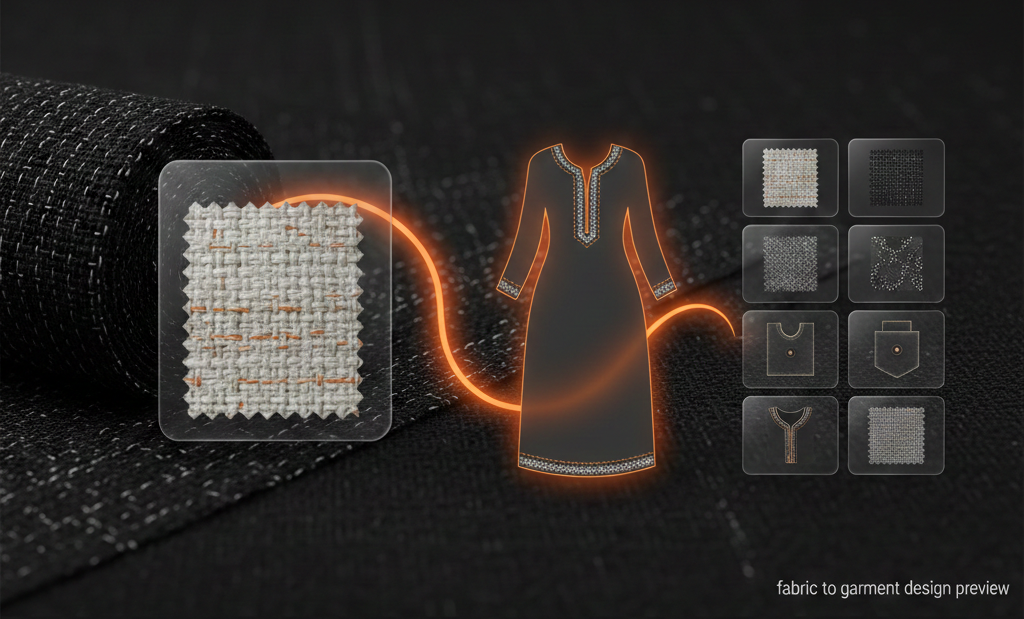
fabric to garment design: showing how fabric looks when stitched into garments
-
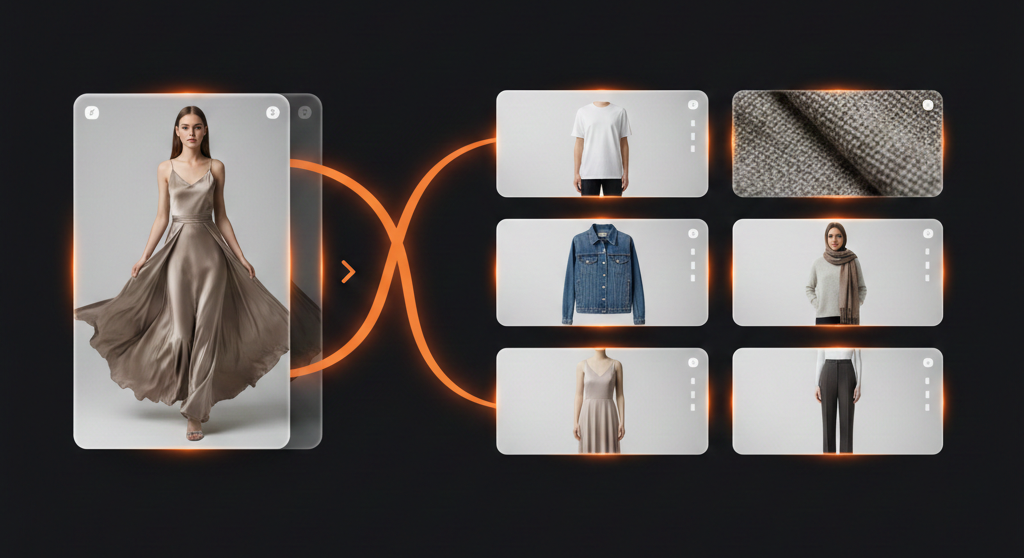
AI garment visualization: on-model or garment-form previews to help decision-making
-
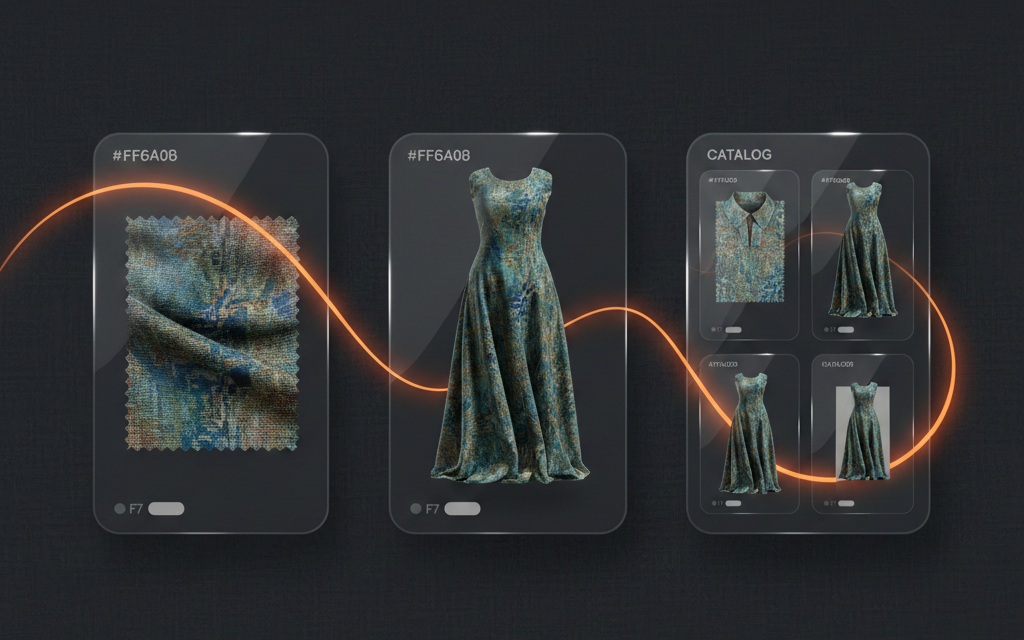
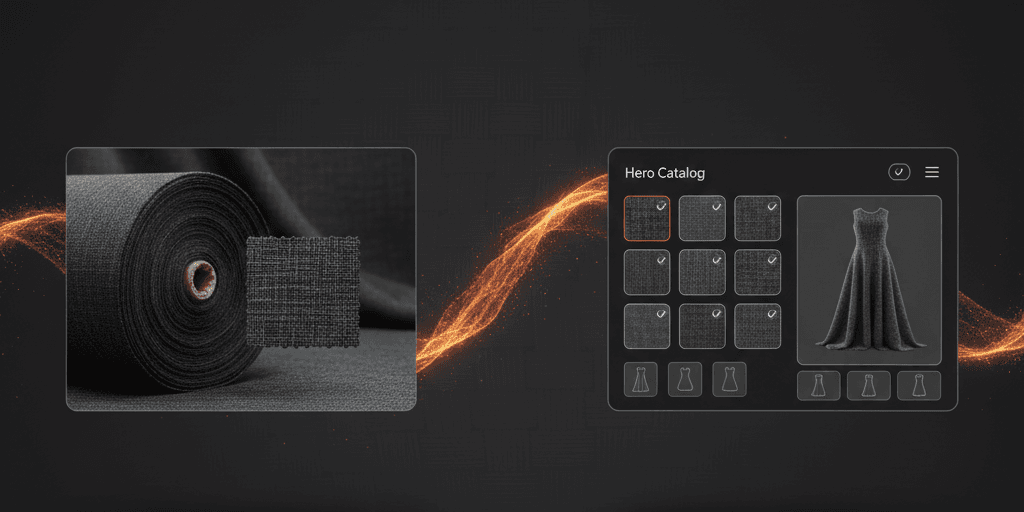
digital textile catalog creation: clean PDF/ZIP/collection-style catalogs for sharing
-
sales-ready assets that support textile sales enablement
This is the shift: from fabric photos to sellable presentation systems.
What changes when you add garment visualization to fabric selling
A major reason buyers delay approvals is that fabric is “raw” it’s a material, not a product. But buyers are usually purchasing fabric for a specific outcome: apparel, uniforms, home textiles, private-label products, seasonal collections.
When you introduce AI garment visualization, you give the buyer a shortcut:
-
They instantly see motif scale at garment size
-
They understand whether it suits their customer segment
-
They can imagine the final assortment (not just the fabric)
-
They approve faster (or reject faster which is also good because it saves time)
This is why digital sampling and 3D visualization are widely discussed as ways to reduce lead times and waste in apparel development. textileworld.com+1
How AI helps reduce sampling delays and cost
Sampling is essential but not every decision should require physical sampling.
In many organizations, the sample cycle becomes repetitive:
-
sample requested too early
-
buyer changes mind after seeing it stitched
-
a second (or third) sample is requested
-
time-to-market slips
AI visualization helps teams reduce textile sampling by improving decisions earlier:
-
shortlist fabrics faster
-
reject unsuitable designs before sampling
-
align internal teams before sending physical prototypes
Industry and academic discussions of digital sampling and 3D prototyping repeatedly emphasize reduced physical samples, shortened approval timelines, and reduced waste/lead time. textileworld.com+2MDPI+2
The practical impact for B2B is simple: fewer cycles, faster approvals, quicker PO movement.
The modern B2B buyer expects digital-ready catalogs
Today’s B2B buyer behaves more like a B2C buyer:
-
they want to review options quickly
-
they want consistent product info
-
they prefer self-serve browsing before meetings
-
they compare vendors faster
So if your presentation is slow, inconsistent, or hard to understand, you lose deals not because your fabric is weaker, but because your experience is weaker.
Many B2B catalog and enablement resources point to the same direction: digital catalogs improve buyer engagement and streamline the ordering process. Flipsnack Blog+1
A strong digital textile catalog backed by AI is not “marketing.” It is sales infrastructure.
Where AI fabric presentation helps most in textile workflows
1) Exporters and mills selling to global brands
Global buyers want:
-
fast shortlists
-
consistent catalog formatting
-
clear visuals for internal approvals
-
fewer physical shipments before alignment
AI catalogs + garment visualization help you become “easy to buy from.”
2) Manufacturers pitching private-label programs
Private label buyers need to imagine final products. Showing fabric to garment design previews makes your pitch stronger:
-
“This is how the fabric reads as a finished garment”
-
“These are three silhouettes this fabric supports”
-
“Here are two colorways in the same print story”
3) Wholesalers and agents building seasonal assortments
Wholesalers win by speed and variety. AI helps them:
-
present larger selections without extra shoot costs
-
keep consistent quality across product visuals
-
build micro-collections for different regions/markets
4) Printing units and job-work suppliers
For print suppliers, visualization is sales:
-
show placement, scale, repeat clarity
-
show how prints look on finished products
-
win approvals faster and reduce rework loops
A simple AI fabric presentation system you can implement
Below is a practical, repeatable system that works for B2B teams. It’s designed so even a small sales team can operate it consistently.
Step 1: Standardize fabric capture
Set a basic capture standard:
-
daylight or softbox lighting
-
fabric flat, minimal folds
-
one wide shot + one close-up detail
-
accurate color (avoid heavy filters)
This improves consistency across catalogs and reduces buyer confusion.
Step 2: Generate textile product visualization assets
Create a consistent set of outputs per fabric:
-
clean swatch view (for quick browsing)
-
detail close-up (texture/print clarity)
-
optional repeat preview (if applicable)
This becomes your baseline fabric swatch presentation.
Step 3: Add fabric to garment design previews
Now the key upgrade: generate 2–4 garment previews for each fabric, depending on your category:
-
kurti/dress/shirt silhouettes for womenwear brands
-
shirts/uniform silhouettes for menswear/uniform buyers
-
loungewear silhouettes for comfortwear buyers
This is where AI garment visualization removes hesitation.
Step 4: Build a digital textile catalog (collection-first)
Instead of sending random images, group them into collections:
-
Summer breathable cottons
-
Festive rich textures
-
Workwear solids and stripes
-
Kidswear playful prints
-
Export neutrals (minimal palette stories)
A catalog that tells a story sells faster than a folder of images.
Step 5: Use sales enablement packaging
Sales enablement is fundamentally about equipping teams with the resources they need to close deals content, tools, knowledge. HubSpot+1
For textiles, your best enablement assets are:
-
catalog PDFs/ZIP packs
-
garment preview decks
-
quick “collection highlights” one-pagers
-
clear MOQ/lead time sheet
-
compliance/testing notes (where relevant)
Step 6: Track buyer approvals like a pipeline
Tag every fabric as:
-
shortlisted
-
needs change (color/scale)
-
approved for sampling
-
approved for production
AI doesn’t just create visuals it helps you create a cleaner approval workflow.
Proof points buyers respond to
B2B buyers don’t want “AI hype.” They want tangible benefits. Here are proof angles that work globally:
Proof angle A: Faster shortlisting
“Here are garment previews so you can shortlist faster before sampling.”
Proof angle B: Reduced sampling loops
“Visualize scale and placement now to avoid re-sampling later.”
Digital sampling and 3D prototyping discussions consistently emphasize reduced sample iterations and shorter development timelines. textileworld.com+2SAGE Journals+2
Proof angle C: Better internal approvals
“Our visuals help your merchandising team approve quickly.”
Proof angle D: Stronger catalog experience
“Here’s a digital textile catalog with consistent presentation and multiple use cases.”
Real examples of AI fabric presentation (easy to imagine)
Use examples like these inside your catalog decks:
Example 1: Cotton floral
-
Swatch view + close-up
-
Garment preview as kurti
-
Garment preview as summer dress
-
Garment preview as casual shirt
Outcome: one fabric becomes multiple product possibilities, increasing buyer interest and speeding approvals.
Example 2: Indigo geometric / heritage-inspired print
-
Swatch + repeat clarity
-
Garment preview as Indo-western top
-
Garment preview as set-style silhouette
Outcome: buyer immediately sees whether it fits their market positioning.
Example 3: Premium textured weave
-
Close-up texture and lighting clarity
-
Garment preview as formal shirt
-
Garment preview as minimal dress
Outcome: texture “reads” as premium when shown as a product, not just a swatch.
How this improves textile exporter marketing (without extra cost)
Textile exporter marketing works best when your outreach is visual and fast.
With AI fabric presentation:
-
your first WhatsApp/email message becomes stronger (garment preview first, swatch second)
-
response rate improves because buyers instantly understand the outcome
-
follow-ups become simpler (“which silhouette do you prefer?” instead of “imagine how it will look”)
This is modern textile sales enablement: fewer words, more clarity.
Where Tameta fits in your workflow
If you’re building a complete visual selling system, Tameta helps you cover the key steps:
-
Fabric visualization → garment preview
-
Catalog outputs for listing and presentations
-
Supporting content through blogs and news updates
Use these internal pages in the blog and in your sales resources:
-
Tameta Catalogs (for catalog creation and listing packs)
-
Tameta Blog (for guides and how-to content)
-
Tameta News (for industry updates and credibility)
External resources worth linking for credibility
To strengthen trust for global buyers and improve SEO, it helps to cite credible industry sources on digital sampling and product development digitization:
-
Textile World on 3D digital sampling benefits (lead times, waste) textileworld.com
-
McKinsey on digital product development and reduced sample costs/time-to-market McKinsey & Company
-
Research on 3D sampling’s effect on sample development time SAGE Journals
-
HubSpot on the meaning of sales enablement (to frame “sales enablement” correctly) HubSpot+1
Conclusion: the new standard for B2B textile selling
B2B textile selling is becoming more digital, more visual, and more speed-driven. The suppliers who win are the ones who make buying easier.
AI fabric presentation is not just a design feature. It’s a sales advantage:
-
better fabric swatch presentation
-
stronger textile product visualization
-
faster textile buyer approvals
-
improved digital textile catalog quality
-
practical fabric to garment design previews that close hesitation
-
a complete system for B2B textile sales and global outreach
If you want to compete globally, the fastest upgrade you can make isn’t only in production t’s in presentation.